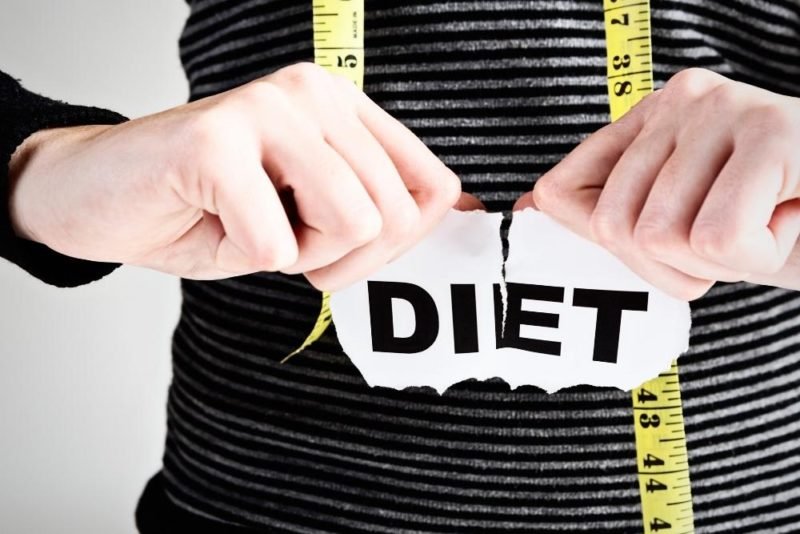
This is the first post in a 10-part series looking at the principles of Intuitive Eating.
If you’ve been reading my blog for a while, it’s highly likely that you have at least a general sense of what Intuitive Eating is. In case you don’t, or you’re a bit fuzzy on the details, Intuitive Eating [1] is an evidenced-based, mind-body health approach, comprised of 10 Principles [2] and created by two dietitians, Evelyn Tribole and Elyse Resch in 1995.
The first principle is “Reject the Diet Mentality,” and while this principle is fundamental to becoming an intuitive eater (which is why it’s the first principle), it looks different depending on your dieting history.
- If you describe yourself as someone who’s “been on every diet under the sun,” part of the rejection process is doing a sort of inventory of every diet you’ve been on, and looking at where it actually got you.
- If you’ve never gone on a specific diet, but have restricted your intake of certain foods, or food in general (such as “watching your portions”) or exercised with the hope of losing weight, then the rejection process might look more like looking at the ways you’ve internalized diet culture.
- If you’re someone who has never dieted, yet struggles with feelings of guilt around food, perhaps with a lack of body trust, then reading about this principle may be a revelation of how diet culture weaves its way into the minds of even those who have not pursued weight loss, per se.
Regardless, learning about this principle proves illuminating whether someone identifies as a dieter or not. Because the diet mentality influences our food choices without taking into account hunger, fullness, food preferences, budget and how much time and energy we have to prepare meals. Again, even for many people who don’t think they’re dieting.

Why not just diet? (Part 1)
The idea of rejecting dieting — and the diet mentality — could seem odd or strange [3]. (Aren’t we supposed to try to control our weight? [4]) Or, giving up dieting may feel synonymous with giving up on having a certain type of body, so even if giving up dieting behaviors feels like a relief, giving up on having a smaller body feels scary or even unthinkable. I totally get that — and I’ve been there –- but here’s some more food for thought:
The process of dieting makes you preoccupied with food, makes food the enemy, makes you feel guilty when you aren’t eating “diet-type” foods, and can slow your metabolism so your body stops losing weight (and may even gain weight) on fewer and fewer calories.
The act of dieting and restricting can also lead to a physical and mental backlash. This may include cravings, bingeing and the “last supper” phenomenon. (That’s the feeling that when you are allowed to have a “bad” or “forbidden” food, you better eat as much as you can because who knows when you’ll have it again. If you’ve ever thought, “My new diet starts on Monday, so I better eat pizza and cheeseburgers and cupcakes this weekend,” then that’s last supper thinking.)
Why not just diet? (Part 2)
The dieters backlash may also leave you unable to trust yourself with food, and perhaps even feeling that you don’t deserve to eat at all because of your weight. You might withdraw from social situations because you’re afraid of being around food you “shouldn’t” eat, or because you’re ashamed of your weight — or a recent weight gain.
Over time, you may find that the amount of time from starting a diet to abandoning that diet becomes shorter and shorter. You notice that your body doesn’t respond to your dieting efforts the way it used to (quite possibly because your metabolism has slowed, thanks to each diet teaching your body to adapt better to the next “famine”).
And then there’s the unfortunate fact that in most people with eating disorders, a diet is what kicked things off. (Yes, there are generally other factors at play, but while genetics and the social environment may load the gun, it’s the diet that pulls the trigger.)
The bottom line is that when you pit dieting against biology, your biology will win. Dieting is a form of short-term starvation, so when you finally allow yourself to really eat, eating can feel intense or even uncontrollable. This is a natural response to starving and dieting—not a lack of willpower!
What kind of eater are you?
This question — and the corresponding section in “Intuitive Eating” is often a bit of a revelation for my clients. It can provide a name for what they are experiencing, and often provides more clarity about their eating behaviors, whether they know they are dieting or not. Some of the biggest surprises come when they realize the things about their eating that are causing them so much distress are linked to dieting (and diet culture [5]) even if they don’t think they are dieters.
- The Careful Eater is motivated by fitness and health, but they often take things too far, leading to over vigilance, and guilt when they don’t eat “perfectly.” The pitfalls here are a horrible relationship with food, equating how “good” your food choices are with how good you are as a human. In more extreme cases, this can lead to orthorexia (an unhealthy obsession with eating healthy), or with an actual eating disorder.
- The Professional Dieter is motivated by feeling fat, or by wanting to avoid weight gain. (There’s a lot of internalized fatphobia there!) When the Professional Dieter isn’t on a diet, they’re thinking about their next diet. The big pitfall here is that yo-yo dieting isn’t good for health or well-being. The cycle of being on a diet, then off a diet doesn’t foster a healthy relationship with food, and can lead to rebound eating, even bingeing.
- The Unconscious Eater feels the need to eat while doing something else, believing that eating while doing nothing else is a waste of time, getting in the way of food satisfaction and noticing fullness cues. Chaotic eaters are busy and overscheduled, and grab whatever food is available. “Refuse not” eaters are vulnerable to visual food cues, motivated to eat simply because food is present. “Waste not” eaters want to the most value for their food dollar, are members of the clean plate club, and are unable to resist free food, even if they aren’t hungry. Emotional eaters use food to cope, and eating is triggered by uncomfortable emotions.

Taking steps to reject the diet mentality
In order to reject the diet mentality, you need to recognize and accept the damage that dieting causes to our bodies and our minds. That can be hard, especially if you’ve been dieting for a long time. No one likes to admit that they’ve invested time, money and effort into something that at best didn’t help them and at worst harmed them.
It’s also important to increase your awareness of diet mentality traits and thinking. Many people find that they have these thought patterns, even if they are not actively dieting.
- This includes the idea that we should “will” our way to weight loss. Unfortunately, willpower is not an infinite resource — it works, until it doesn’t anymore because you’ve run out — and it erodes with each choice we make and each stressor we deal with over the course of the day.
- Obedience is another trait, but sooner or later, trying to do the “right” thing all the time leads to resistance, and with food that can include rebound eating or binging.
- And then there’s failure. Specifically, the idea that if you can’t stick to a diet, or you lose weight only to regain it, then you’ve failed. The diet industry makes big money off these feelings, because when you feel you’ve failed at a diet, rather than realizing that the act of dieting is destined to fail every time for about 95 percent of people, then you just become a repeat customer. Think about it: If diets worked, there would be fewer dieters over time. That’s bad for business…if you’re in the business of selling diets.
Once you’re to the point where you realize that dieting sucks and that you are NOT a non-compliant failure who has no willpower whatsoever, it’s essential to get rid of the tools of dieting.
Dieting tools to lose
The number one dieting tool to lose is the bathroom scale, because as you’ve probably experienced, the number on the scale can totally affect the tenor of your day. Both “good” and “bad” scale numbers can trigger overeating. (“Good” numbers can lead to celebratory overeating, and “bad” numbers can lead to comfort eating as you try to cope with feelings of guilt or shame.) That’s bananas, when you consider that many things affect scale weight that have nothing to do with changes in body fat. Water retention, anyone?
(What about food scales you ask? If it’s the type of scale you can use to measure ingredients when baking — which is really the most precise way to bake — and that’s what you’re using it for, then keep it. I also use mine to weigh coffee beans when we’re using our fancy, looks-like-a-chemistry-set siphon coffee maker [6]. We bought it after experiencing one in the Dubai Coffee Museum [7] about five years ago.)
Number two are any diet- or weight-focused books and magazines you have in the house. When I finally gave up dieting for good (as I was in grad school to become a dietitian), I recycled stacks of “Oxygen,” “Muscle & Fitness Hers” and “Clean Eating” magazines, all of which totally fed my disordered eating and compulsive exercise. I gave away books that promoted dieting in any way, shape or form, even those under the guide of “fitness.”
To that, I would add editing your email newsletter subscriptions and social media feeds. There are so many dietitians, therapists, personal trainers and everyday people to follow who are affirming of all bodies, so why not curate a social media feed or email inbox that uplifts you rather than feeding body shame?

Self-compassion and boundaries
Finally, rejecting the diet mentality calls for being compassionate toward yourself. The reason that so many people are perpetually on diets is that it’s easy to be pulled into the dieting world and seduced by the so-called “benefits” of dieting [8]. When I watch some of the TV ads for popular diet programs or apps [9], I marvel at the evil genius ninja wizardry of their marketing departments. Heck, if I didn’t know better, I myself would fall for their promises.
It’s also worth noting that for some people — especially women — dieting creates a common bond with other dieters. I see this a lot with women who join diet programs that have group meetings or forums, but even if your dieting efforts have been mostly solo, engaging in diet talk [10]is a common bonding ritual with friends and family who are also dieting.
Making friends who are also exploring Intuitive Eating — and setting boundaries [11] around diet talk with those in your circle who always go there in conversations — can help reduce triggers and possibly sow positive seeds with other dieters you know. Maybe one day they’ll say, “Hey…can you tell me more about Intuitive Eating?”
Next post: “Principle 2: Honor Your Hunger [12].“
This post contains Amazon Affiliate links. As an Amazon Associate I earn from qualifying purchases.
Disclaimer: All information provided here is of a general nature and is furnished only for educational purposes. This information is not to be taken as medical or other health advice pertaining to an individual’s specific health or medical condition. You agree that the use of this information is at your own risk.
Hi, I’m Carrie Dennett [13], MPH, RDN, a weight-inclusive registered dietitian, nutrition therapist and body image counselor. I offer compassionate, individualized care for adults of all ages, shapes, sizes and genders who want to break free from eating disorders, disordered eating or chronic dieting [14]. If you need to learn how to manage IBS symptoms [15] with food, or improve your nutrition and lifestyle habits [16] to help manage a current health concern or simply support your overall health and well-being, I help people with that, too.
Need 1-on-1 help for your nutrition, eating, or body image concerns? Schedule a free 20-minute Discovery Call [17] to talk about how I can help you and explore if we’re a good fit! I’m in-network with Regence BCBS, FirstChoice Health, Providence of Oregon Health Plan and United Healthcare, and can bill Blue Cross and/or Blue Shield insurances in many states. If I don’t take your insurance, I can help you seek reimbursement on your own. To learn more, explore my insurance and services areas page [18].