In case you haven’t noticed, we live in a culture obsessed with moralizing our bodies, our plates, and our metabolic health.For decades, diet culture has handed us rigid scripts on how to eat, what to weigh, and how to repent for taking up “too much” space — especially if you’re fat* AND female, non-white, queer, neurodivergent, and/or disabled.
*For the record, I use the word “fat” as a neutral descriptor of size.
But just when we thought we had micromanaged every macro, labeled every food group as “good” or “bad,” and internalized a lifetime of wellness-industry guilt, a new cultural paradigm arrived: GLP-1 receptor agonists. These medications have fundamentally rewritten the rules of appetite, weight loss, and biological desire.
With these drugs came a sweeping cultural shift (I would personally love to be able to watch a streaming show without being pelted with GLP-1 ads at every commercial break). And tucked inside that shift is a peculiar, deeply insidious psychological trap: the pressure to become a “good fatty.” Let’s look at what that term mean and, more importantly, why is it time to burn that tired old trope to the ground?

The anatomy of the ‘Good Fatty’
Historically, the phrase “good fatty” meant someone in a fat body who could decouple themselves from the full stereotype — lazy, unfit, unhealthy, eats too much — by being able to say, “Look! I may be fat, but my labs are perfect!” or “Look! I may be fat, but I’m only eating a salad and then I’m going to the gym!” or “Look! I may be fat but I’m trying really, really hard not to be!”
But in the modern, pharma-adjacent wellness landscape, a “good fatty” has taken on a new layer, becoming the fat person taking a weight-loss medication who performs their transformation correctly. They:
- Lose weight rapidly, but not so rapidly that they look “unhealthy”
- Publicly credit discipline, portion control, and “lifestyle changes” while conveniently downplaying or entirely omitting the complex biochemistry of a weekly injection
- Eat tiny, aesthetically pleasing portions of protein and greens and never complain about side effects like nausea or fatigue
- Submit quietly to the medical establishment’s applause, proving that given the right pharmaceutical tool, they could finally fix their “brokenness”
In short, while a “good fatty” still seeks absolution by shrinking, they now have the use of a modern medication to conform to society’s deepest, oldest prejudices.
If you are a person living in a larger body — or someone navigating the rollercoaster of appetite-suppressing medications — the pressure to perform this role can feel suffocating. You are only a “good” patient, a “good” consumer, and a “good” person if your body ultimately bends to the narrow metrics of conventional thinness. But even when you use science to alter your biology, you may still feel like you’re on probation.
The GLP-1 Paradox: freedom, faux-morality and double standards
There is no denying that GLP-1 medications have benefitted many people, especially those with type 2 diabetes who have found other diabetes medications ineffective for managing their condition. I have an acquaintance who has a family history of liver disease often requiring a liver transplant. GLP-1s have improved her liver enzymes so dramatically that she may never have to face having a liver transplant herself.
I’ve previously written about how, as a weight-inclusive nutrition therapist [1], I believe in body autonomy, which, by extension includes both the right to choose to take a GLP-1 for weight loss and the right to decline to take a GLP-1 despite pressure from doctors, friends, family, media, or society. To take one of these medications or not is a deep, nuanced conversation I’ve had with many of my clients.
Part of that conversation often includes the unfortunate facts that
- people in larger bodies often already feel some degree of judgment about their bodies, but
- the cultural machinery surrounding GLP-1s has added an additional layer of moral judgment, treating weight loss via GLP-1s with a bizarre double standard.
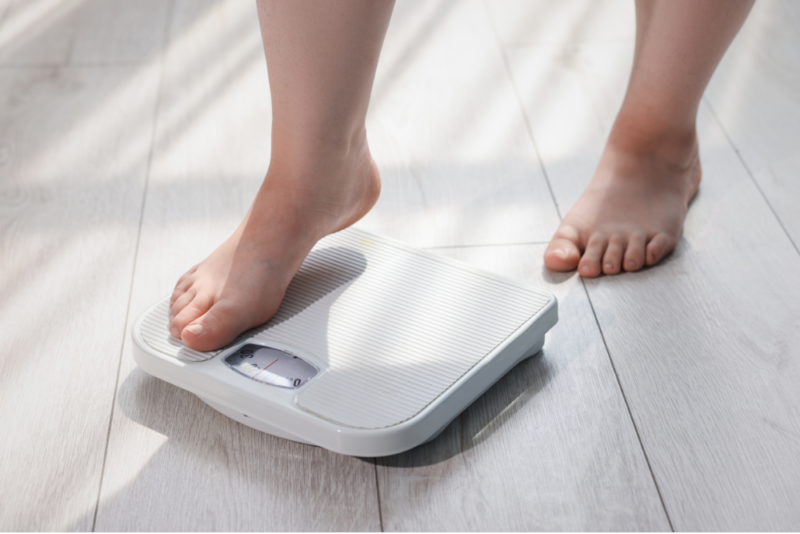
The double-edged sword of praise and stigma
On one hand, people taking GLP-1s are often suspected or even outright accused of “cheating,” of taking the easy way out. (I’m so sick of fitness bros who post on social media that “people don’t need GLP-1s, they just need to ‘work harder,’” as if they know anything at all about the science of weight and weight loss…or how hard many people in larger bodies have already worked to try to become smaller.)
On the other hand, if someone successfully loses weight, they’re rewarded with the ultimate societal currency: praise. “You look amazing! What’s your secret?”
To be a “good fatty” is to navigate this fine line. You must accept the praise for your shrinking form while simultaneously performing virtue by ensuring everyone knows you are still working hard and eating clean. You aren’t allowed to just exist. Every pound lost is scrutinized as either a testament to your newfound moral fiber or proof of your medical compliance.
Related Post: Your doctor recommended a GLP-1 for weight loss. Now what? [2]
The nutritional fallout of performing ‘goodness’
When the primary goal is becoming a “good fatty” — meaning you prioritize compliance over actual biological nourishment— your nutrition can take a severe hit.
In clinical practice, I’ve witnessed the fallout of this pressure, and have talked with many colleagues who have their own accounts from their own clients. When people start GLP-1s, their appetite often plummets drastically. If their guiding motivation is the cultural mandate to eat as little as possible to maximize weight loss, they slip into severe undereating.
They become proud of eating only a few bites of protein a day, treating food like an annoying chore rather than essential fuel. But the human body is not a backwards bank account where depositing fewer calories always yields a better life. When you chronically under-eat on a GLP-1:
- You lose precious muscle mass: Rapid weight loss without adequate protein and resistance training causes a significant loss of lean tissue, including muscle [3] [TW: this article is a good explainer, but it does view weight loss as a positive] slowing metabolism and possibly leading to frailty.
- Side effects compound: Nausea, fatigue, hair loss, and severe gastrointestinal distress often trace directly back to a lack of balanced, gentle nutrition [4].
- Your relationship with food fractures further: Instead of healing your relationship with eating, the medication simply becomes a new tool for restriction — just one that finally forces your biology to comply with your eating disorder or diet-culture conditioning.
Trying to be a “good fatty” forces you into a starvation loop, disguised as health.
 [5]
Redefining what matters: moving beyond compliance
If we want to survive the GLP-1 era with our sanity, our metabolic health, and our self-worth intact, we have to stop playing the game of being “good.”
Your body is not a moral report card. Whether you use a GLP-1, choose not to use one, or are somewhere in the messy and uncertain middle, your worth has nothing to do with how easily your body conforms to cultural expectations of size.
So, what does authentic, gentle nutrition look like when we strip away the performance of “goodness”?
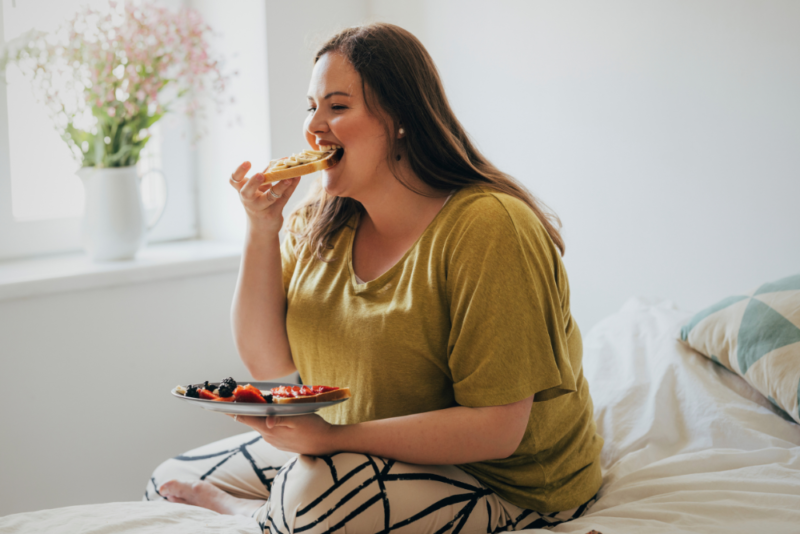
- Prioritizing nourishment over smallness: If you’re eating less because your appetite is naturally lower, the goal shifts from eating as little as possible to making every bite count. That means focusing on nutrient-dense foods, adequate protein to protect your muscles, and gentle carbohydrates that give you steady energy — even when eating feels like a neutral mechanical task rather than a joy.
- Dropping the public relations campaign: You do not owe anyone an explanation for your medical choices, your body size, or your plate. You are allowed to take up space — in conversations, in healthcare settings, and in the world — without apologizing for your biology.
- Redefining health beyond the scale: True health encompasses mental well-being, stable energy, strength, joy, and peace of mind. If a medication or a way of eating leaves you anxious, malnourished, and obsessively tracking your shrinking reflection, it is not serving your well-being, no matter how many compliments it buys you.
Breaking free in the age of GLP-1s
The era of GLP-1s is not going away, nor should we dismiss a tool that brings relief to many. But I think we need to change the conversation around it.
Letting go of the desire to be a “good fatty” means giving up the exhausting project of trying to make everyone else comfortable with your body. It means stepping off the stage of moralized weight loss and choosing a radically different question: “How can I support, nourish, and respect the body I am in right now, exactly as it is?”
I also feel very strongly that there needs to be some collectivism in this, because on an individual level, being “good” and doing what it takes to “fit in” can mean survival. The more intersecting identities you have (again, female, non-white, queer, neurodivergent, and/or disabled), the more pressure you may feel to “fix” the one thing you might possibly be able to control — your body size.
Ultimately, you don’t need to be a “good fatty.” You deserve to be a human being allowed to live, eat, and breathe without earning your right to exist. And that’s a hill I am willing to die on.

Disclaimer: All information provided here is of a general nature and is furnished only for educational purposes. This information is not to be taken as medical or other health advice pertaining to an individual’s specific health or medical condition. You agree that the use of this information is at your own risk.
Hi, I’m Carrie Dennett [6], MPH, RDN, a weight-inclusive registered dietitian, nutrition therapist and body image counselor. I offer compassionate, individualized care for adolescents adults of all ages, shapes, sizes and genders who want to heal from an eating disorder, disordered eating or chronic dieting [1], cultivate an accepting, respectful relationship with their bodies, and gain the freedom to live an authentic, meaningful life without obsessing about food.
Need 1-on-1 help for your nutrition, eating, or body image concerns? Find out how to get started [5]. I’m in-network with Regence BCBS, FirstChoice Health, Providence of Oregon Health Plan and United Healthcare, and can bill Blue Cross and/or Blue Shield insurances in many states. If I don’t take your insurance, I can help you seek reimbursement on your own. To learn more, explore my insurance and services areas page [7].